
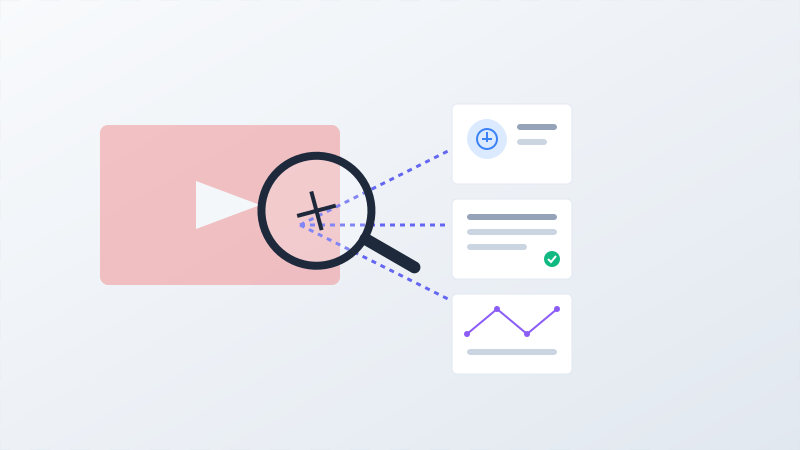
There are two ways to use YouTube.
The first is the Default Mode. You open the app. The algorithm serves you a thumbnail. You click. You watch. You get a hit of dopamine. You click the next one. Two hours later, you close the tab, vaguely entertained but with nothing to show for it.
The second is the Researcher Mode. You open the app with a specific intent. You ignore the homepage. You extract the data you need. You synthesize it. You close the tab in 20 minutes with a new mental model, a solved problem, or a completed task.
Most people are stuck in Default Mode. They treat YouTube like television—a passive stream of entertainment. But for the modern knowledge worker, YouTube is not TV. It is the world's largest, most up-to-date library of human knowledge.
Treating it like a TV is a waste of a superpower. Here is how to switch gears and watch like a researcher.
The Mindset Shift: Algorithm vs. Agency
The fundamental difference between a consumer and a researcher is Agency.
The Consumer (Passive)
- ●Trigger: Boredom or notification.
- ●Selection: "What does the algorithm want me to see?"
- ●Goal: Entertainment / Distraction.
The Researcher (Active)
- ●Trigger: A specific question or problem.
- ●Selection: "What solves my current bottleneck?"
- ●Goal: Information Extraction / Utility.
Phase 1: The Pre-Watch Filter
A researcher never clicks a video just to "see what it's about." That is how you get sucked into a 3-hour documentary about competitive cheese rolling.
Before you press play, you must define your Information Gap.
Ask yourself: "What specifically am I trying to learn?"
- Bad Intent: "I want to learn about React." (Too broad, invites endless watching)
- Good Intent: "I need to understand how `useEffect` handles cleanup functions." (Specific, verifiable, finite)
If you cannot state your intent, do not click.
Phase 2: Active Extraction (During the Watch)
Consumers watch linearly. They start at 0:00 and finish at 10:42.
Researchers watch non-linearly. They treat a video like a document. You wouldn't read a dictionary cover-to-cover to find one word. Why watch a whole tutorial to find one step?
1. Scan the Structure
Look at the chapters/timestamps first. Jump directly to the section that answers your specific question.
2. Variable Speed
2x speed for context/stories. 1x speed for complex logic. Pause for implementation. Your playback speed should be constantly changing.
3. The Stop Rule
The moment you find the answer to your Pre-Watch question, stop watching. Close the video. You are done.
Phase 3: The Synthesis (Post-Watch)
Watching is not learning. Only synthesis is learning.
If you close the video and immediately open another one, you have wasted your time. The information is in your short-term memory buffer, and it will be overwritten by the next video.
To lock it in, you must Transform the information.
The Feynman Test
Can you explain the core concept to a 5-year-old (or a colleague) without looking at the video? If not, you didn't understand it. You just recognized it.
This is where most people fail. They don't take notes because it breaks the flow. They don't summarize because it feels like homework. So they stay in the loop of endless consumption.
Automating the Drudgery
The reason we don't research properly is that the manual work—transcribing, timestamping, summarizing—is high-friction. It's boring.
This is exactly what AI is for. Not to do the thinking for you, but to do the processing for you.
Pause video. Type note. Rewind. Listen again. Type more. Lose train of thought.
Paste link. Get instant transcript & structured summary. Chat with the video to extract specific answers. Spend your energy on understanding, not scribing.
Free to try. No credit card required.
Conclusion
Information is abundant. Attention is scarce.
When you watch like a consumer, you are paying with your attention and getting fleeting entertainment in return. When you watch like a researcher, you are investing your attention and getting permanent knowledge in return.
The choice is yours. Next time you see that red play button, ask yourself: "Am I here to watch, or am I here to learn?"