
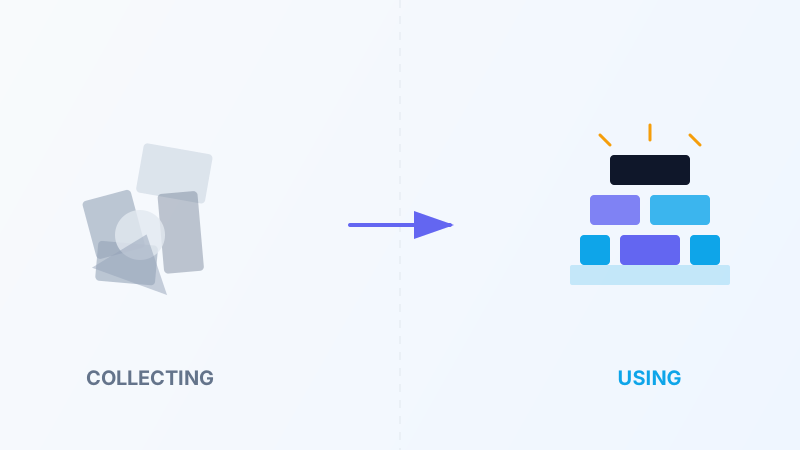
We are all digital hoarders.
Look at your browser bookmarks. Look at your "Watch Later" playlist on YouTube. Look at your Pocket or Instapaper queue. Look at your notes app.
If you are like most knowledge workers, you are sitting on a mountain of potential energy. You have collected thousands of articles, podcasts, courses, and PDFs. You have built a personal library that would make the Library of Alexandria jealous.
But here is the uncomfortable truth: Collecting information is not the same as acquiring knowledge. And it is certainly not the same as building wisdom.
In fact, for many of us, the act of collecting has become a dangerous substitute for doing the work. It is what we call the Collector's Fallacy: the false belief that "knowing about" something is the same as "knowing" it.
Why We Hoard: The Illusion of Competence
Why do we do this? Why do we save 50 articles on "How to Start a Business" but never actually start one?
It is biological. When you find a valuable piece of information, your brain releases a hit of dopamine. For our ancestors, finding a new berry bush or a water source was a matter of survival. Your brain rewarded you for discovering resources.
Today, information is infinite, but your brain's reward system hasn't updated. Clicking "Save to Notion" or "Add to Favorites" triggers that same ancient reward. You feel productive. You feel like you've accomplished something.
But you haven't. You've just moved bits from one server to another.
The Collector vs. The Architect
To break this cycle, we need to shift our identity. We need to move from being Collectors (who gather) to Architects (who build).
The Collector
The Architect
Just-In-Case vs. Just-In-Time
The Collector operates on Just-In-Case (JIC) logic. "I'll save this article on keto recipes just in case I decide to go on a diet next year." "I'll bookmark this Python tutorial just in case I want to learn to code someday."
The problem with JIC is that "someday" rarely comes. And when it does, that article is likely outdated, or you've forgotten you even saved it.
The Architect operates on Just-In-Time (JIT) logic. This is how manufacturing plants like Toyota operate. They don't stockpile parts. They get exactly what they need, exactly when they need it.
In knowledge work, this means: Don't consume information unless you have an immediate use for it.
It sounds radical. But try it. Next time you see an interesting headline, ask yourself: "Do I have a project right now that this helps me with?"
- If the answer is YES: Read it, take notes, and apply it immediately.
- If the answer is NO: Let it go. Trust that if you need it later, you can find it (or something better) then.
The "One Touch" Rule for Knowledge
To stop hoarding, implement the One Touch rule. When you consume something valuable, you must "touch" it by transforming it. You cannot just save it. You must do one of three things:
Summarize It
Rewrite the main idea in your own words. If you can't explain it simply, you didn't understand it.
Critique It
Write down why you disagree with it. Conflict creates strong memories.
Connect It
Link it to something else you know. "This reminds me of..." is the most powerful phrase in learning.
Stop Saving. Start Building.
The goal of a knowledge management system isn't to have a perfect archive. It's to produce better work.
This is why we built NotefyAI. We realized that the friction of summarizing and organizing was keeping people in "Collector Mode."
NotefyAI handles the heavy lifting of processing—turning raw audio, video, and text into structured summaries—so you can skip straight to the "Architect" phase. It doesn't think for you; it clears the workspace so you can think.
Don't let your insights die in a "Read Later" folder. Use them.