
You sit in a lecture, laptop open, fingers flying across the keyboard. You capture everything. The professor's exact words. The slide titles. The examples. You leave with 3,000 words of pristine notes.
Two weeks later, you remember almost nothing.
Meanwhile, your classmate Sarah took maybe half a page of notes. But she can explain the concepts clearly, connect them to other ideas, and apply them in new contexts. She didn't just collect information. She created knowledge.
The difference? Sarah understood something fundamental that most people miss: there are three distinct levels of information processing, and most people never get past the first one.
The Three Levels of Knowledge Creation
Notes
Raw capture of information
What was said
Summaries
Structured organization of key points
What was important
Insights
Personal understanding and applications
What it means to you
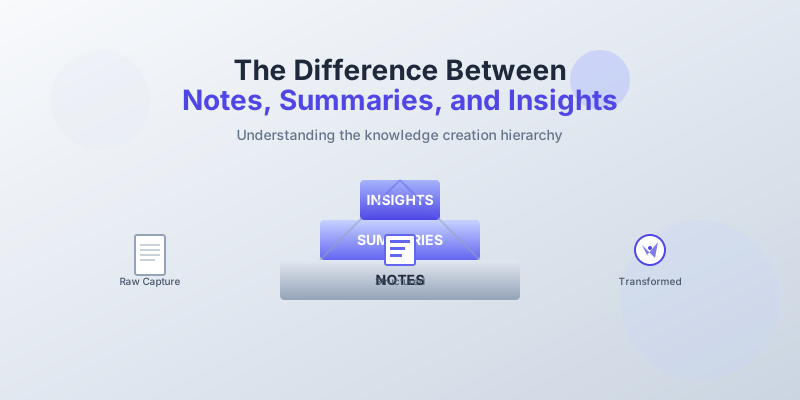
The Knowledge Pyramid: Most people spend their time at the base, collecting notes. But real learning happens at the peak, where insights transform how you think and act.
Level 1: Notes - The Raw Material
Notes are the what. They are the raw capture of information as it was presented to you. The lecture transcript. The book quotes. The meeting minutes. The voice memo you recorded while walking.
Notes are faithful servants. They record faithfully, but they don't discriminate. They capture the profound and the trivial with equal enthusiasm. The professor's brilliant insight about quantum mechanics gets the same treatment as their aside about what they had for lunch.
Characteristics of Good Notes
- Complete: Capture the full context, not just fragments
- Accurate: Faithful to the original source material
- Organized: Structured enough to find later
- Searchable: Tagged and categorized for retrieval
But here's the crucial insight: notes are not knowledge. They are the ingredients for knowledge, just as flour, eggs, and sugar are ingredients for cake. You can't eat the ingredients. You need to transform them.
Most people mistake the map for the territory. They confuse having 3,000 words of notes with understanding 3,000 words worth of concepts. They mistake collection for comprehension.
Level 2: Summaries - The Distillation
Summaries are the so what. They are what happens when you take your raw notes and ask: "What actually matters here?" You compress, organize, and structure the information into something more manageable.
If notes are like photographing every page of a book, summaries are like writing a book review. You're not just capturing; you're beginning to process. You're separating signal from noise.
Raw Notes (What to Avoid)
"The meeting started at 2pm. John was late again. Sarah presented the Q3 results showing 15% growth in the enterprise segment. The coffee was terrible. We discussed the new marketing strategy for 20 minutes. Mike disagreed with the budget allocation. We decided to postpone the product launch until Q2."
Too much noise, not enough signal
Good Summary (What to Aim For)
Key Decision: Product launch postponed to Q2
Reason: Need more time for market validation
Impact: Budget reallocation required
Next Steps: Sarah to provide detailed Q3 analysis by Friday
Actionable insights, clear decisions
Summaries are powerful because they force you to make choices. You can't include everything, so you have to decide what's truly important. This act of selection is the beginning of real learning.
But summaries still aren't insights. They are organized information, but they haven't yet become your information. They are still someone else's ideas, just more efficiently packaged.
Level 3: Insights - The Transformation
Insights are the now what. They happen when you take summarized information and integrate it with everything else you know. When you ask: "How does this change what I believe? How does this change what I do?"
Insights are when the information becomes yours. When you can explain it to someone else using your own words and examples. When you can apply it in contexts the original source never imagined.
The Insight Creation Process
1. Connect
Link new info to existing knowledge
2. Question
Challenge assumptions and implications
3. Apply
Use in new contexts and situations
Here's the profound difference: When you have an insight, you don't need to refer back to your notes. The concept has been integrated into your mental model. It has become part of how you think.
Real Insight Example
Original Concept (Summary): Parkinson's Law states that "work expands to fill the time available for its completion."
Personal Insight: This explains why I'm always busy but rarely productive. When I give myself "all day" to write a report, I spend 6 hours procrastinating and 2 hours actually writing. But when I have only 2 hours before a meeting, I somehow produce the same quality work.
Application: I'm going to start setting artificial deadlines for all my important work. Instead of "write report this week," I'll block 9-11am tomorrow and treat it like the real deadline.
Notice how the insight goes beyond understanding Parkinson's Law. It connects it to personal experience, reveals a pattern, and leads to concrete behavioral change. That's the alchemy of insight.
The Transformation Process: How to Move Up the Pyramid
Understanding these levels is only half the battle. The real question is: how do you systematically move from notes to summaries to insights?
The key is to treat each level as a separate, deliberate step. Don't try to do everything at once.
The 3-Step Knowledge Creation Workflow
Capture (Notes Phase)
Focus exclusively on accurate collection. Don't worry about importance or understanding yet. Your job is to be a faithful recorder.
Distill (Summary Phase)
Now ask: what's important? What are the key points? Compress without losing meaning. Organize for clarity.
Integrate (Insight Phase)
Finally, make it yours. Connect to existing knowledge. Question assumptions. Plan applications.
The magic happens when you separate these steps. When you try to capture and summarize simultaneously, you end up with incomplete notes and shallow summaries. When you try to summarize and create insights at the same time, you generate superficial insights based on incomplete understanding.
The Common Pitfalls (And How to Avoid Them)
The Collector's Fallacy
Mistaking quantity for quality. Thinking that more notes equals more knowledge.
Set processing quotas: for every hour of content you consume, spend 30 minutes processing it into summaries and insights.
The Procrastination Trap
Saving everything for "later" but never actually processing it.
Process immediately after consumption while the context is fresh. Use the 24-hour rule: no raw notes older than a day.
The Surface Skimmer
Jumping straight to insights without proper foundation in the material.
Respect the hierarchy. Never create insights from someone else's summaries. Always work from your own complete notes.
The Isolation Error
Creating insights in isolation without connecting to your existing knowledge base.
Use linking and association techniques. Always ask: "What does this remind me of? What does this contradict?"
The Technology Advantage: Why AI Changes Everything
Here's where things get interesting. For most of human history, the bottleneck in knowledge creation was the mechanical work of capturing and organizing information. The scribe copying manuscripts. The student transcribing lectures. The researcher organizing index cards.
But we live in an age where that mechanical work can be automated. AI can transcribe your meetings, summarize your articles, and organize your thoughts. This doesn't make human insight obsolete. It makes it more important than ever.
The New Knowledge Creation Workflow
AI Handles:
- Transcription and capture
- Initial summarization
- Organization and linking
- Search and retrieval
You Focus On:
- Personal connections
- Critical questioning
- Creative applications
- Wisdom synthesis
This is the real promise of AI in knowledge work. Not to replace human thinking, but to eliminate the mechanical barriers that prevent us from doing the thinking. When AI handles the transcription and initial summarization, you're free to focus on what humans do best: making connections, questioning assumptions, and creating new understanding.
The Realization: You Don't Need More Information
We live in an age of information abundance. The problem isn't access to information; it's the ability to transform that information into knowledge and wisdom.
Most people respond to information overload by trying to consume more, faster. They install speed-reading apps, listen to podcasts at 2x speed, and skim articles while multitasking. But they're just becoming more efficient at collecting ingredients they'll never cook with.
The real competitive advantage isn't consuming more information. It's having a systematic process for transforming the information you do consume into insights that change how you think and act.
The Knowledge Creation Checklist
Before you consume any piece of content, ask yourself:
Am I willing to spend 2-3x the consumption time on processing?
What's my system for faithful note-taking?
What's my schedule for processing raw notes?
What's my process for connecting and applying?
The most successful people I know aren't the ones consuming the most information. They're the ones with the most systematic approach to turning the information they do consume into insights that change their behavior.
They understand that the goal isn't to have perfect notes. The goal isn't even to have comprehensive summaries. The goal is to have insights that change how you think and act. Everything else is just preparation for that moment of transformation.
Start today. Pick one piece of content you consumed recently. Don't just review your notes. Take them through the full transformation process. Distill them into a summary. Then push through to create a genuine insight that changes how you'll approach something in your life.
Because in the end, the difference between notes, summaries, and insights isn't just academic. It's the difference between being a consumer of information and being a creator of knowledge. Between being informed and being transformed. Between having information at your fingertips and having wisdom in your bones.
Ready to transform your learning process?
If this framework resonates with you, you might appreciate how NotefyAI automates the mechanical parts of knowledge creation, freeing you to focus on the insights that matter.
Focus on insights, not busywork. It's free to try.