
You finish a 3-hour Huberman Lab podcast. You feel smarter. You feel optimized. You have "downloaded" the information into your brain.
But two days later, a friend asks you, "What was that protocol for morning sunlight again?"
And you blank.
You remember that there was a protocol. You remember it was important. But the specific details—the "how," the "why," and the "when"—are gone.
This is the defining struggle of the Information Age. We have unlimited access to the world's best teachers, yet most of us are stuck in a cycle of Information Bulimia: bingeing on high-quality content, only to purge it from our memory almost immediately.
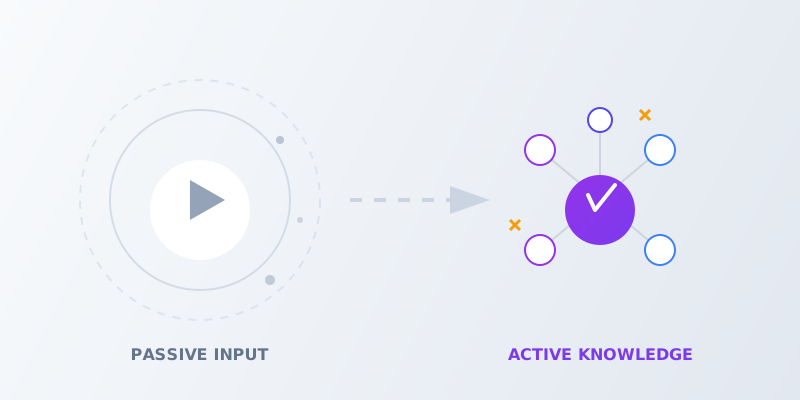
The problem isn't your memory. The problem is that you have confused Watching with Learning.
The Core Distinction
Watching is a passive act. It requires zero effort from your prefrontal cortex. It is "Lean Back" mode.
Learning is an active act. It requires friction. It is "Lean Forward" mode.
- ●Input flows over you like water.
- ●You recognize the logic in the moment.
- ●Result: Illusion of Competence.
- ●You stop the flow to grapple with ideas.
- ●You reconstruct the logic yourself.
- ●Result: Neural Rewiring.
The "Translation" Gap
To move from watching to learning, information must undergo a transformation. It cannot stay in its original format (video/audio). It must be translated into your format.
Think of it like food. You cannot just swallow a whole apple and expect it to nourish you. You have to chew it, digest it, and break it down into nutrients.
Notes are the digestion process of learning.
When you take a note, you are forced to:
- Select: Decide what is worth keeping.
- Compress: Turn a 5-minute explanation into a 1-sentence summary.
- Connect: Link it to what you already know.
If you don't do this, you haven't digested the content. It passes right through you.
Why We Don't Do It: The Friction Trap
We all know we should take notes. So why don't we?
Because it ruins the experience.
You are watching a fascinating video. The flow is good. You don't want to pause, find your notebook, uncap your pen, and scribble down a thought. It breaks the immersion. It feels like work.
So we make a bargain with ourselves: "I'll remember this."
(Narrator: He did not remember this.)
Solving the Paradox
We are left with a paradox:
- To learn, we must process information (take notes).
- To enjoy content, we must avoid friction (not take notes).
For years, the only solution was discipline. You just had to force yourself to be a diligent student, pausing and writing, pausing and writing.
But now, we have a third option. We can use technology to decouple the consumption from the capture.
Have Your Cake and Eat It Too
Imagine watching that Huberman Lab podcast without pausing once. You just sit back, absorb, and enjoy the flow.
But when it's over, you have a perfect, structured summary of every protocol, every study, and every tool mentioned—waiting for you in your inbox.
1. You do the Watching
Focus on the big picture. Let the ideas wash over you. Enjoy the narrative.
2. NotefyAI does the Catching
It captures the transcript, extracts the key points, and structures the data. It does the "digestion" for you.
Now, "Learning" becomes easy. You don't have to start from a blank page. You start with a high-quality summary. Your job is simply to read it, highlight the 2-3 things that matter most, and apply them.
Free to try. No credit card required.
The Choice
You can continue to be a spectator. You can watch thousands of hours of content and have nothing to show for it but a vague sense of familiarity.
Or you can become a learner. You can build a library of wisdom that actually improves your life.
The difference isn't intelligence. The difference is your system.