
Open your bookmarks bar. Or your "Watch Later" playlist on YouTube. Or that "Saved" folder on Twitter/X.
What do you see?
If you are like most people, you see a graveyard. A list of hundreds, maybe thousands of links that you saved with the best intentions. "This looks important," you told yourself. "I need to read this." So you clicked save, felt a tiny hit of dopamine for being so responsible, and moved on.
And then? You never opened them again.
We call this the "Collector's Fallacy." It is the dangerous belief that "saving" information is the same as "acquiring" it. It is not. In fact, saving links often prevents us from learning, because it gives us the false satisfaction of action without the hard work of comprehension.
Why We Hoard Links
Why do we do this? Why do we keep adding to a pile we know we will never finish? It comes down to Fear and Identity.
"What if this article has the one secret that changes my career? I can't risk losing it." So we save it as an insurance policy against ignorance.
When we save a complex article on "Quantum Computing," we are signaling to ourselves: "I am the kind of person who reads about quantum computing." The save button validates our aspirational self.
The Friction of Retrieval
The problem isn't just that we save too much. It is that retrieving saved content is incredibly high-friction.
When you look at a bookmark from six months ago, you have lost the context.
- Why did I save this?
- Was it for a specific project?
- Was it for a general interest?
- Is it even relevant anymore?
To "process" that link, you have to click it, wait for it to load, re-read the intro to remember what it's about, and then decide if it's worth your time. That is too much work. So your brain chooses the path of least resistance: ignore it and scroll Twitter.
A list of links is a list of unmade decisions. And unmade decisions are exhausting.
The Fix: Process or Perish
To break this cycle, you need a new rule: Never save a link without a next step.
"Read Later" is a lie. You need to change the default action from "Save" to "Process."
1. The 2-Minute Rule
If the content can be consumed in less than 2 minutes, do it now. Don't defer it. The cost of managing the bookmark is higher than the cost of reading it.
2. The "Why" Rule
If you must save it, you must write a note explaining why. "Useful for Project X marketing strategy." If you can't articulate why, delete it.
3. The Extraction Rule
Don't save the container (the link). Save the contents (the insight). Extract the key point and discard the URL.
Stop Saving. Start Extracting.
The "Extraction Rule" used to be hard. You had to read the whole thing, highlight, copy-paste, and organize.
NotefyAI makes it instant.
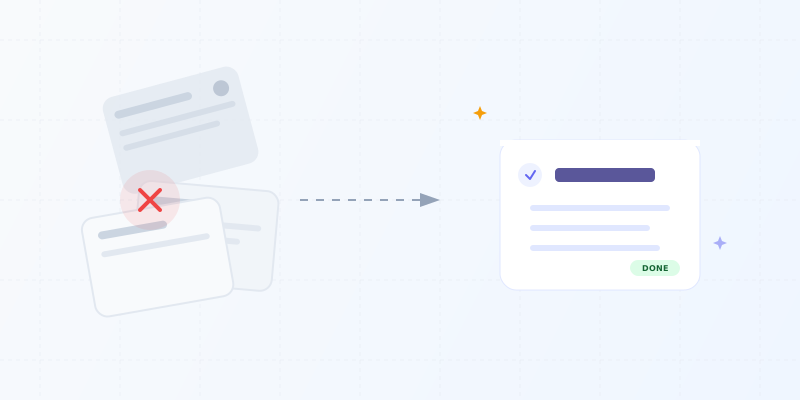
- ❌ Save link to "Read Later"
- ❌ Forget why you saved it
- ❌ Never look at it again
- ✅ Paste link into NotefyAI
- ✅ Get instant summary & key insights
- ✅ Save the knowledge, not the link
Free to try. No credit card required.
Conclusion
Your "Read Later" list is weighing you down. It is a psychological burden of unfulfilled promises to yourself.
Declare bankruptcy. Delete the links from 2023. You aren't going to read them. And for the new ones? Don't just save them. Process them. Extract the value. And then move on.
Knowledge is not what you save. It is what you understand.