
You sit in a meeting, laptop open, typing furiously. You capture every decision, every action item, every brilliant insight. You feel productive. You are documenting everything.
Three months later, you need to find that specific detail about the project timeline. You open your notes app and stare at a wall of text. You scroll. You search. You remember typing it, but you cannot find it. Eventually, you give up and email a colleague to ask what was decided.
Sound familiar? You are not alone. Research suggests that over 80% of digital notes are never accessed again after they are created. We have become masters of capturing information and amateurs at retrieving it.
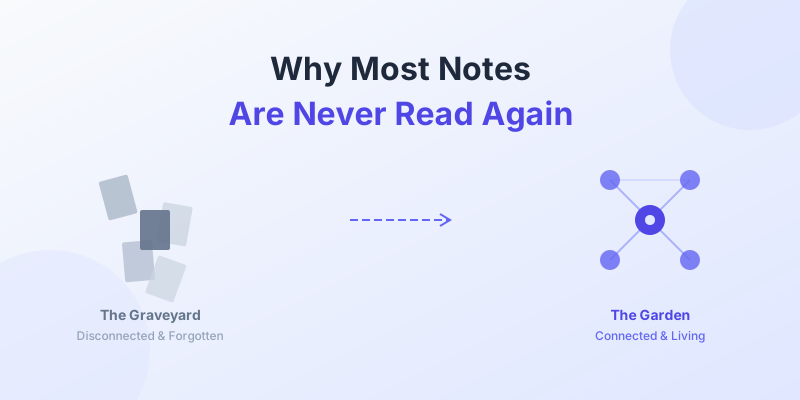
This is the Note Graveyard Problem. We create thousands of notes throughout our lives, but most become digital tombstones—markers that we once knew something, but no longer do.
The Note Graveyard: Where Good Ideas Go to Die
The problem is not that we are bad at taking notes. The problem is that we are taking notes using systems designed for a different era—systems that assume we will manually organize, review, and connect everything we capture.
Capture Without Purpose
We save everything because we can, not because we should
Lost in the Noise
Important insights buried under mountains of trivial details
No Review System
Notes created and forgotten, never revisited or reinforced
The result is what I call "Productivity Theater"—the satisfying feeling of being busy without actually being productive. We type thousands of words that we will never read again, creating an illusion of learning while building a digital landfill of forgotten thoughts.
Why Your Brain Abandons Your Notes
The Note Graveyard Problem is not a technology problem. It is a cognitive problem. Our brains are wired to prioritize creation over retrieval, collection over connection, and novelty over review.
The Dopamine Trap
Taking notes feels productive. Each keystroke gives a small dopamine hit, rewarding the act of capture while ignoring the act of retrieval.
You are addicted to collecting, not connecting
The Context Collapse
When you write a note, you know exactly why it matters. Months later, that context is gone, and the note becomes meaningless.
Your future self lacks your present context
Consider how we naturally organize information in the physical world. Your kitchen spices are grouped by cuisine. Your clothes are arranged by season and occasion. Your bookshelf might separate fiction from non-fiction, favorites from reference materials. Each system reflects how you actually use these items.
But digital notes? They go into chronological order, or worse, a single massive folder labeled "Notes." It is like throwing all your possessions into one giant box and expecting to find your winter coat in July.
The Missing System: From Capture to Connection
The solution is not to take fewer notes. It is to build a system that transforms notes from dead storage into living knowledge. A system that understands that the value of a note lies not in its creation, but in its connection to other ideas and its ability to resurface when needed.
The Three Pillars of Usable Notes
Intelligent Capture
Save with purpose. Every note should answer a question or solve a problem you actually have.
Automatic Connection
Your system should suggest related ideas automatically, not rely on you to remember connections.
Strategic Resurfacing
Good notes should find you when you need them, not wait for you to search.
Think of it as building a personal knowledge assistant that works even when you are not thinking about it. Instead of a graveyard, you create a garden where ideas cross-pollinate and resurface in unexpected ways.
The Transformation: From Graveyard to Garden
Let me show you what happens when you apply this system to real note-taking scenarios. The difference is not incremental—it is transformational.
The Old Way: Static Notes
Meeting Notes - March 15, 2024:
"Discussed new marketing strategy. Sarah mentioned TikTok ads. Budget concerns raised. Need to analyze competitor spending. Follow up next week."
Result: Never found again. Three months later, you are recreating the same analysis from scratch.
The New Way: Living Knowledge
Marketing Strategy Insight:
"TikTok ads show 3x ROI for our demographic. Budget allocation: 30% TikTok, 40% Google, 30% Facebook. Competitor analysis shows they spend $50k/month on TikTok."
Result: Automatically surfaces when you work on budget planning. Connected to related research.
The difference is not just better writing. It is a fundamental shift from passive storage to active knowledge building. Every note becomes a node in a growing network of understanding, automatically connected to related ideas and strategically resurfaced when relevant.
Building the Bridge: Technology as Memory Extension
The tragedy of the Note Graveyard Problem is that we already have the technology to solve it. We just have not been using it correctly. Instead of building systems that work with how our brains naturally process and retrieve information, we have been forcing ourselves to adapt to rigid, hierarchical folder structures.
The New Knowledge Architecture
Semantic Understanding
AI understands content, not just keywords
Network Thinking
Ideas connected by meaning, not folders
Proactive Retrieval
Knowledge finds you when you need it
The future of knowledge management is not about building better filing cabinets. It is about creating intelligent systems that understand the meaning of your notes and actively help you build connections between ideas.
The Realization: Your Notes Are Meant to Be Used
The Note Graveyard Problem persists because we have accepted it as inevitable. We have convinced ourselves that taking notes is inherently wasteful, that most of what we capture will never be useful, that the act of writing things down is more important than the act of retrieving them.
But this is learned helplessness. Your notes are not meant to be digital tombstones. They are meant to be the building blocks of your intellectual life, the raw material from which you construct understanding, the scaffolding that supports your growth and development.
Every note you take represents a moment of insight, a piece of information that mattered enough to preserve, a building block that could contribute to something greater. When you let these notes die in digital graveyards, you are not just losing information—you are losing pieces of your potential self.
The Knowledge Revival Checklist
Before you take your next note, ask yourself:
If you cannot answer, you probably do not need the note
Set a specific timeframe for revisiting this information
Use tags, links, or categories that match how you think
Build bridges between ideas, not isolated islands
The goal is not to take perfect notes. The goal is to build a living knowledge system that grows more valuable over time, that helps you think better, decide better, and create better. A system where every note has the potential to resurface at exactly the right moment, transforming from forgotten information into timely wisdom.
Stop building graveyards. Start building gardens. Your future self—and all the insights you have not yet discovered—will thank you for it.
Ready to rescue your notes from the graveyard?
If this resonates with your experience, you might appreciate how NotefyAI turns passive note-taking into active knowledge building—automatically connecting your insights and surfacing them when you need them most.
Transform your note graveyard into a knowledge garden. It's free to try.