
You buy a new notebook. A Moleskine, perhaps. Or maybe you download a shiny new app like Notion or Obsidian. You feel a surge of optimism. "This is it," you tell yourself. "This is the system that changes everything."
Two weeks later, the notebook is collecting dust, or the app is a graveyard of half-finished lists and "Untitled" pages.
Why does this happen? We’re smart, capable people. We know taking notes is important for learning and memory. So why does the simple act of writing things down feel like pushing a boulder up a hill?
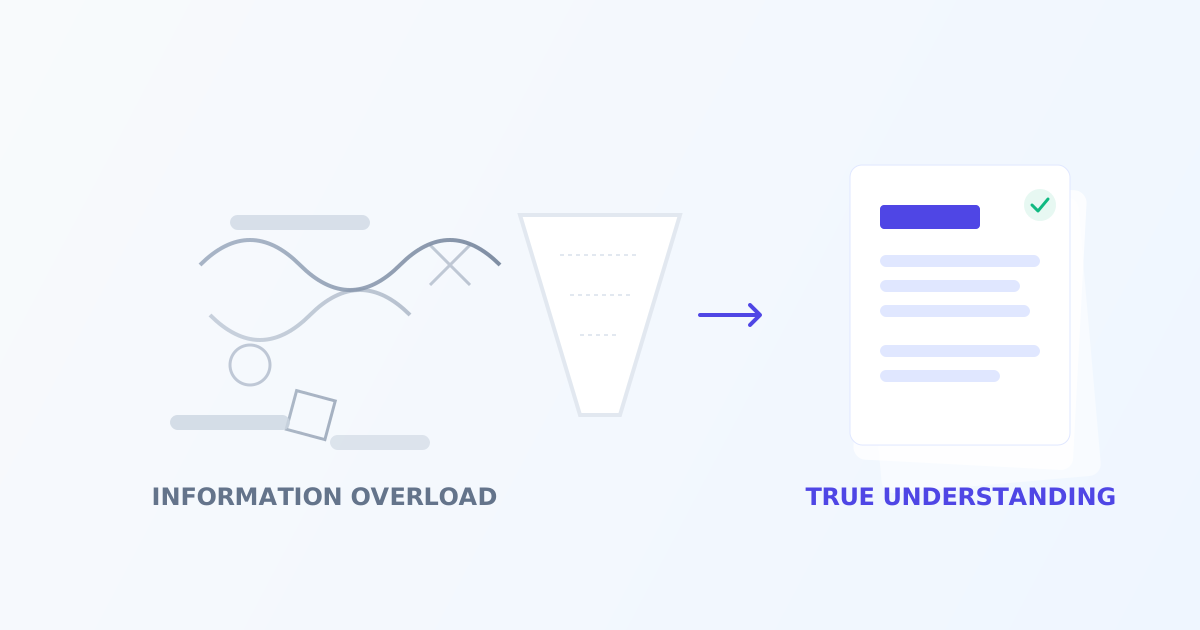
The answer isn’t that you’re lazy or disorganized. It’s that we’ve been taught the wrong way to take notes. We treat note-taking as a storage problem, when it’s actually a filtering problem.
The Collector's Fallacy
There is a dangerous sensation that feels exactly like learning, but isn't. It's called The Collector's Fallacy.
It happens when you bookmark a tweet, save a PDF, or highlight a passage in a book. That little hit of dopamine? That's your brain rewarding you for "acquiring" knowledge. But here's the catch: saving isn't knowing.
The Hoarder
- Saves 100+ links to "read later"
- Highlights 50% of the page
- Feels productive while capturing
- Result: Overwhelmed and can't find anything
The Architect
- Captures only what resonates
- Summarizes in own words
- Connects new ideas to old ones
- Result: Builds a library of wisdom
The Friction of "Filing"
The second reason note-taking fails is friction. Traditional systems ask you to make too many decisions upfront.
"Where should I save this? Is it a Project? An Area? A Resource? Which folder? Which tag?"
Every decision costs mental energy. If you have to think about where to put a note before you write it, you often won't write it at all. The friction of organization kills the flow of capture.
The "Capture First, Sort Later" Method
The most robust systems separate Capture from Processing. They acknowledge that your "Capturing Self" (busy, in a rush) is different from your "Organizing Self" (thoughtful, reflective).
Quick Capture
Dump everything into one "Inbox". No sorting. No tagging. Just get it out of your head.
Weekly Review
Once a week, empty the inbox. Delete the trash. File the gems. Connect ideas.
Action
Use your notes to create content, solve problems, or make decisions.
Enter Artificial Intelligence
This is where things get interesting. For decades, the bottleneck was the Processing step. We could capture easily (voice memos, screenshots), but processing them into usable text took hours.
AI has flipped this equation.
Now, you can record a rambling 20-minute voice note while walking your dog. An AI can transcribe it, remove the "ums" and "ahs," extract the key action items, and format it into a clean summary.
The goal isn't to let AI do your thinking. It's to let AI do the drudgery - the transcription, the formatting, the initial sorting - so you can spend 100% of your energy on the actual insights.
Your "Second Brain" Shouldn't Be a Second Job
We built NotefyAI because we were tired of note-taking systems that required more maintenance than they provided value.
We wanted a tool where you could dump a raw voice note, a messy meeting recording, or a long YouTube video, and instantly get back a perfectly structured, usable note.
It’s not about replacing your mind. It’s about clearing the clutter so your mind can do what it does best: create.